You’ve probably scrolled past countless social media posts showing murky water after someone’s Listerine foot soak, claiming miraculous results. But here’s what’s actually happening at the molecular level: those essential oil compounds—thymol, eucalyptol, and menthol—aren’t just freshening your breath anymore. They’re disrupting microbial cell membranes and penetrating layers of dead keratin on your feet. The question isn’t whether these mechanisms exist; it’s whether they’re strong enough to matter clinically, and that’s where things get complicated.
The Antifungal Power of Essential Oil Terpenes in Mouthwash Formulations
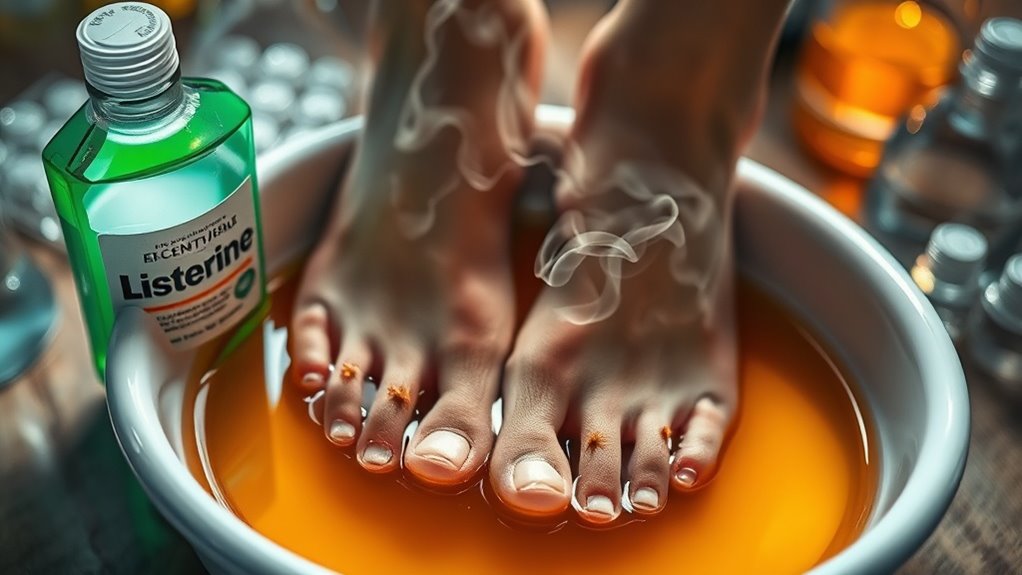
Mouthwash formulations contain multiple classes of monoterpenes—thymol, eugenol, menthol, and related compounds—that demonstrate documented antifungal activity against both Candida species and dermatophytes in controlled laboratory settings. Phenolic terpenoids like thymol and eugenol disrupt fungal plasma membranes, causing cellular leakage and fungicidal outcomes at concentrations in the low hundreds of ppm.
Oxygenated monoterpenes such as terpinen-4-ol inhibit spore germination and hyphal growth through membrane perturbation. In vitro minimum inhibitory concentrations for these compounds typically range from 0.4–4.0 μL/mL against susceptible fungi. The high alcohol content in these formulations also contributes to their antimicrobial efficacy by denaturing microbial proteins and disrupting cellular structures. Eugenol’s antibacterial properties complement its antifungal action, making it particularly effective as an oral antiseptic that has been valued across multiple therapeutic traditions. However, translating laboratory efficacy to a listerine foot soak presents challenges: effective concentrations depend heavily on formulation matrix, bioavailability through keratinized tissue, and sustained contact time—variables rarely replicated in typical home applications.
How Chemical Exfoliation and Keratolysis Remove Dead Skin and Calluses
When you apply alcohol-based Listerine to your feet, the ethanol (typically 21.6–26.9% v/v in original formulations) temporarily disrupts lipid bilayers in the stratum corneum, increasing permeability and hydration of cornified layers.
Elevated temperatures from warm soaking water further enhance this effect by accelerating enzymatic desquamation kinetics and reducing keratin crosslink stability. The astringent properties of Listerine’s active compounds also contribute to callus softening by drawing out moisture from thickened skin layers. However, clinical evidence specifically linking Listerine’s alcohol concentration and typical soak durations to measurable keratolytic outcomes comparable to established AHA, BHA, or urea-based treatments remains limited.
Unlike detoxification foot baths where the visible brown water is simply caused by electrode corrosion rather than toxin removal, any observed benefits from Listerine soaks would need to be attributed to its active ingredients rather than pseudoscientific mechanisms.
Alcohol Softens Stratum Corneum
Although Listerine’s alcohol content ranges from 21.6% to 26.9% depending on formulation, short-chain alcohols—primarily ethanol and smaller amounts of related compounds—exert measurable effects on stratum corneum integrity that warrant careful examination.
Ethanol extracts intercellular lipids from the stratum corneum, reducing the lipid matrix that limits water flux. This lipid disruption increases transepidermal water loss (TEWL) and decreases skin capacitance—measurable indicators of impaired barrier integrity. Simultaneously, alcohol denatures structural proteins in corneocytes, altering keratin conformation and decreasing mechanical cohesion.
| Alcohol Effect | Mechanism | Observable Outcome |
|---|---|---|
| Lipid extraction | Disrupts lamellar phase | Increased TEWL |
| Protein denaturation | Alters keratin structure | Reduced cohesion |
| Enzyme modification | Changes KLK5/PLA2 activity | Enhanced desquamation |
However, concentration and exposure duration critically determine whether these effects produce therapeutic keratolysis or irritant damage. Among simple alcohols, ethanol exhibits the mildest effects on keratinocytes compared to isopropanol and n-propanol, making it a relatively tolerable agent for controlled foot soak applications.
Heat Drives Keratolysis
Keratolytic efficacy depends not only on chemical composition but also on environmental conditions that modulate reaction kinetics and tissue penetration.
When you soak your feet in warm Listerine, elevated temperature accelerates enzymatic breakdown of corneodesmosomes—the proteins binding corneocytes together—while increasing molecular diffusion rates of active ingredients into intercellular spaces. Heat reduces mechanical stiffness of corneified tissue, making chemical cleavage more efficient. Thermal softening also enhances tissue hydration in callused skin, diminishing stratum corneum resistance to keratolysis. The acids function as chemical exfoliants by stimulating skin healing through controlled disruption of the outermost cornified layers.
Higher local temperature increases blood flow and metabolic activity in perilesional tissue, theoretically supporting faster clearance and reepithelialization. Clinical protocols sometimes exploit this temperature-dependent effect with warmed solutions, though whether a home foot soak reaches sufficient thermal dose remains uncertain. Callus thickness inherently limits penetration—heat partially overcomes this barrier.
Broad-Spectrum Antiseptic Action Against Bacteria and Odor-Causing Pathogens
When you apply a Listerine soak, the ethanol and phenolic compounds (thymol, eucalyptol, menthol) exert rapid bactericidal effects across a broad spectrum of cutaneous microbes, including odor-producing Corynebacterium and Staphylococcus species that metabolize keratin and sweat into volatile malodorous compounds. This antiseptic action measurably reduces bacterial biomass within minutes of exposure, yielding short-term odor suppression—though clinical data remain largely anecdotal and small-scale. While Listerine’s antifungal and antibacterial properties are well-established for oral care applications, clinical studies specifically evaluating its efficacy for foot fungus are still needed.
However, repeated or prolonged use can disrupt the normal skin microbiome, potentially selecting for resistant strains or causing contact dermatitis, so you should approach daily antiseptic soaking with caution and discontinue if irritation develops. The benzoic acid component in Listerine also contributes to the exfoliation process by breaking down the bonds between dead skin cells, making it easier to remove callused tissue after soaking.
Rapid Bacterial Kill Spectrum
Listerine’s antimicrobial potency stems from the combined action of four principal agents: ethanol (typically 21–27% in original formulations), thymol, eucalyptol, and menthol. Ethanol denatures proteins and disrupts lipid membranes within seconds, delivering rapid bactericidal effects against Gram-positive and Gram-negative organisms. Thymol and eucalyptol impair cell walls and enzymatic function, while menthol permeabilizes membranes, facilitating deeper penetration into biofilms.
| Pathogen class | Representative organisms | Primary mechanism | Time to kill | Clinical relevance |
|---|---|---|---|---|
| Odor bacteria | Corynebacterium, Brevibacterium | Membrane disruption | Seconds–minutes | Reduces volatile compounds |
| Gram-positive cocci | Staphylococcus spp. | Protein denaturation | <1 minute | Controls skin colonizers |
| Dermatophytes | Trichophyton spp. | Cell-wall damage | 30–60 minutes | Athlete’s foot improvement |
| Yeast | Candida spp. | Synergistic inhibition | 15–30 minutes | Mixed infections |
Synergy between alcohol and essential oils broadens spectrum and accelerates kill rates versus single agents.
Microbiome Balance and Overuse
Broad-spectrum antiseptics don’t distinguish between beneficial commensals and pathogens—a feature that drives both efficacy and potential harm. When you soak your feet in mouthwash, its essential oils and alcohol reduce bacterial diversity on epithelial surfaces, producing dysbiosis.
This creates ecological niches where opportunistic organisms—particularly fungi—can expand after competitors are eliminated. Repeated exposure exerts selective pressure; surviving strains show increased tolerance through cross-resistance mechanisms documented in vitro.
Prolonged moist soaking and incomplete drying sustain sublethal concentrations that favor resistant phenotypes rather than eradication. While short-term bacterial kill reduces volatile organic compounds and odor, disproportionate antibacterial versus antifungal activity may permit dermatophyte persistence.
Individuals with impaired barrier function or diabetes face compounded risks from microbiome disruption. Clinical evidence quantifying real-world selection pressure remains absent.
The Synergistic Role of Vinegar, Epsom Salt, and Ph in Enhanced Antimicrobial Activity
Although individual components of Listerine foot soaks demonstrate measurable antimicrobial properties, the synergistic enhancement claims warrant careful examination of the underlying mechanisms.
You’ll find three proposed synergistic pathways:
-
pH modulation: Vinegar’s acetic acid lowers environmental pH to 2.5-3.0, theoretically creating conditions hostile to dermatophytes while potentiating essential oil penetration
-
Osmotic stress amplification: Epsom salt’s magnesium sulfate increases osmotic pressure, potentially disrupting fungal cell membranes when combined with Listerine’s phenolic compounds
-
Multi-target antimicrobial action: Thymol, menthol, and acidic environment attack different cellular pathways simultaneously
However, controlled studies demonstrating true synergy—where combined effects exceed additive individual contributions—remain limited. You’re fundamentally applying multiple antimicrobial stressors concurrently, though whether this constitutes genuine pharmacological synergy requires further investigation. The cooling sensation from menthol and eucalyptol provides immediate symptomatic relief while the antiseptic properties work to eliminate underlying pathogens responsible for foot conditions.
What Clinical Evidence Reveals About Effectiveness and Limitations for Foot Infections
Fewer than five randomized controlled trials have directly assessed Listerine’s efficacy for foot fungal infections, leaving the evidence base substantially weaker than marketing claims suggest. Most supporting data derive from anecdotal reports and small observational series that lack standardized mycological endpoints.
Systematic reviews consistently rank Listerine below agents tested in rigorous RCTs—tea tree oil and prescription antifungals—due to absent dedicated large-scale trials.
In vitro antifungal activity of thymol and eucalyptol doesn’t guarantee in vivo cure; nail-plate penetration barriers prevent adequate tissue concentrations during simple soaks. Even when mycological cultures turn negative, complete clinical resolution remains elusive, reflecting persistent biofilm and subungual reservoirs.
You’re relying on mechanistic plausibility rather than robust clinical proof, with potential for contact irritation complicating prolonged use. The antimicrobial properties of thymol and menthol in Listerine may disrupt microbial cell membranes, but this activity occurs primarily at the skin surface rather than penetrating deeper tissue layers where infections persist.
Safe Application Protocols, Optimal Soak Duration, and When to Seek Professional Care
Before immersing your feet in any Listerine mixture, you must verify skin integrity—open wounds, fissures, active blisters, or signs of bacterial superinfection (erythema with purulent drainage, expanding red streaks, edema) constitute absolute contraindications. Perform a patch test combining Listerine with vinegar on intact skin; observe for 24 hours before proceeding. If you’re managing diabetes, peripheral artery disease, or immunocompromise, defer to podiatric consultation rather than self-treatment.
Validated Soak Parameters:
- Duration: 45–60 minutes daily for dermatophyte clearance; 15–20 minutes suffices for keratolytic effects
- Formulation: Equal parts original yellow Listerine and warm water; alternative ratios incorporate white vinegar (1:1:2)
- Post-soak protocol: Complete desiccation mandatory; apply urea-based emollient
Seek professional intervention if fungal colonization persists beyond three months or any inflammatory sequelae emerge.
References
- https://www.healthline.com/health/listerine-foot-soak
- https://www.medicalnewstoday.com/articles/317588
- https://www.youtube.com/watch?v=Jl8uX6mDEus
- https://www.michiganfootdoctors.com/athletes-foot-fungus-listerine-soak/
- https://pubmed.ncbi.nlm.nih.gov/7923507/
- https://www.sciencemuseum.org.uk/objects-and-stories/medicine/listers-antisepsis-system
- https://www.scielo.br/j/bjft/a/6LZqrbHQ7GQfY7Cn76mpYMK/
- https://pmc.ncbi.nlm.nih.gov/articles/PMC7922942/
- https://journals.asm.org/doi/10.1128/aac.01050-10
- https://discovercbd.com/blogs/cbd-news/essential-oils-and-terpenes