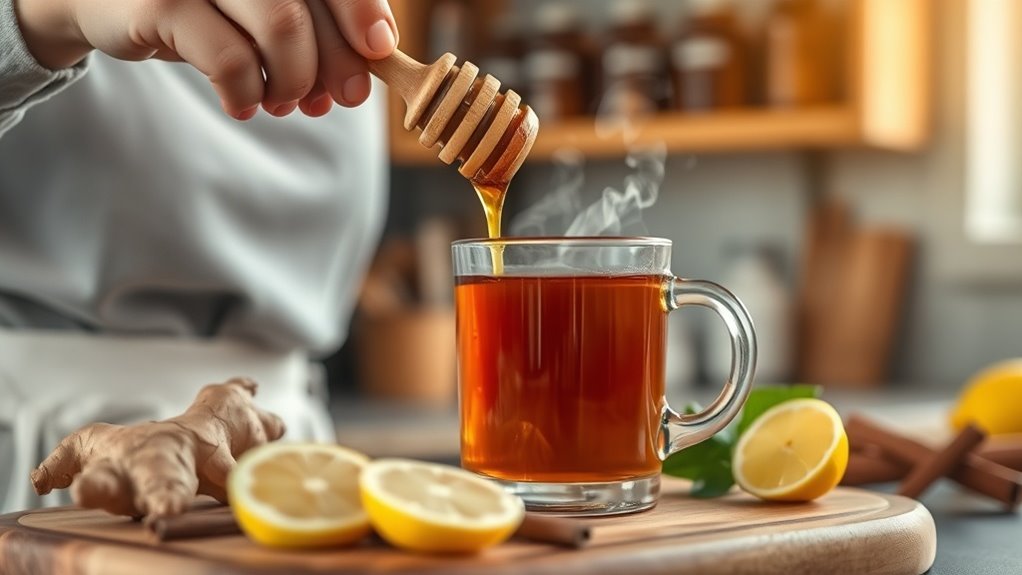

You’ve probably reached for honey when a persistent cough kept you awake at night, but you might not understand why it actually works. While many folk remedies lack scientific support, honey’s effectiveness isn’t just anecdotal—it’s backed by clinical research and well-documented biochemical mechanisms. From its physical properties to its antimicrobial compounds, honey targets coughs through multiple pathways that modern medicine has only recently begun to fully appreciate.
Honey Creates a Protective Throat Coating That Calms Irritation
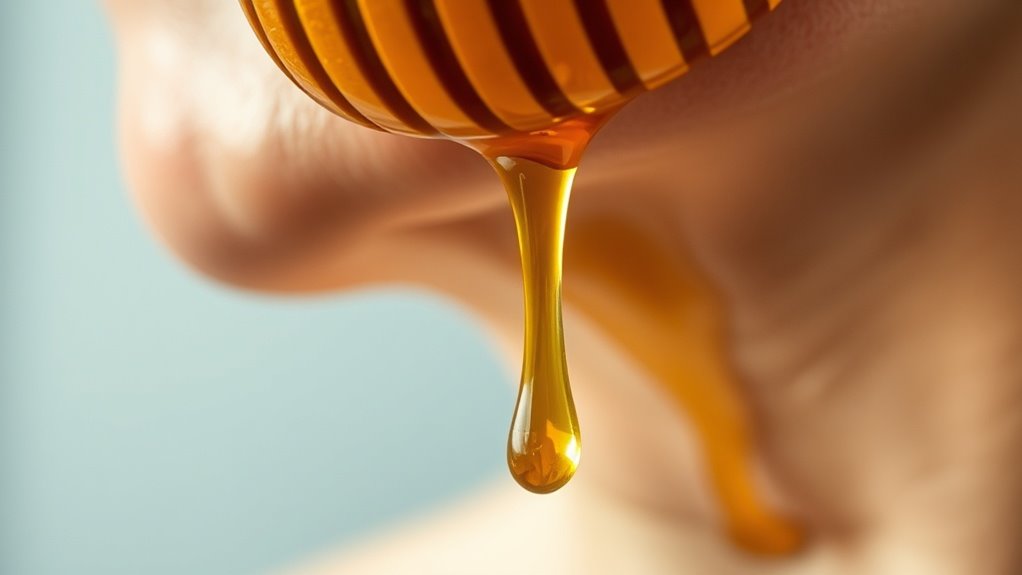
When you swallow honey, its high viscosity and dense molecular structure create a physical film that adheres directly to the pharyngeal mucosa, forming a protective barrier between irritated tissue and the mechanical forces of breathing and swallowing. This coating reduces friction during deglutition, decreasing cough reflex activation triggered by tissue abrasion.
The film’s prolonged contact time—owing to honey’s resistance to clearance—sustains soothing action far longer than aqueous natural cough remedies. By shielding hypersensitive sensory nerve endings from irritants such as pollutants, acid reflux, and particulate matter, honey dampens C-fiber and mechanoreceptor activation. Clinical evidence demonstrates that this protective mechanism reduces cough frequency by 36%, making it significantly more effective than many conventional interventions.
Darker, minimally processed honeys retain greater molecular complexity and thickness, optimizing barrier function. Warm preparations preserve viscosity without denaturing bioactive enzymes, maximizing therapeutic coating properties while avoiding heat-induced degradation. Modern research supports honey’s effectiveness as a cough suppressant, validating centuries of traditional use in respiratory care.
Natural Antimicrobial Properties Fight Respiratory Infections
Beyond its physical soothing action, honey delivers a sophisticated antimicrobial arsenal directly to infected respiratory tissues. Its concentrated sugars create high osmolarity that draws water from bacterial cells, reducing pathogen viability. Enzymatically produced hydrogen peroxide exerts bacteriostatic effects, while methylglyoxal in Manuka honey provides peroxide-independent antibacterial activity. Phenolic compounds disrupt bacterial membranes and metabolic pathways.
| Antimicrobial Mechanism | Active Component | Clinical Impact |
|---|---|---|
| Osmotic dehydration | Concentrated sugars | Inhibits bacterial growth |
| Oxidative damage | Hydrogen peroxide | Bacteriostatic/bactericidal effects |
| Direct cytotoxicity | Methylglyoxal (MGO) | Kills drug-resistant strains |
| Membrane disruption | Phenolics/flavonoids | Impairs virulence pathways |
This multi-targeted approach inhibits antibiotic-resistant respiratory strains, including MRSA, and disrupts established biofilms. Recent research shows that Manuka honey can effectively combat Mycobacterium abscessus, a highly drug-resistant pathogen that causes serious lung infections in individuals with cystic fibrosis and bronchiectasis. The same hydrogen peroxide that makes honey effective against respiratory pathogens also demonstrates potent antiviral activity against various infections. Randomised trials demonstrate honey reduces cough severity and improves symptom resolution when added to standard therapy.
Anti-Inflammatory Compounds Reduce Airway Sensitivity

While honey’s antimicrobial effects target pathogens directly, its anti-inflammatory compounds address a fundamental driver of persistent coughing: airway hypersensitivity. Phenolic compounds in honey—particularly in Manuka, Gelam, and buckwheat varieties—demonstrate measurable anti-inflammatory activity. You’ll find these compounds upregulate anti-inflammatory cytokines IL-10 and IL-1ra while modulating TNF-α expression, effectively reducing airway inflammation in asthma models. Similar to how natural remedies can reduce prostaglandin E2 production in damaged skin tissue, honey’s polyphenolic constituents work to downregulate inflammatory pathways in respiratory tissues.
Aerosolized honey at 25-50% concentrations suppresses eosinophil infiltration and inhibits goblet cell hyperplasia in bronchoalveolar lavage fluid. Gelam honey (40-80% v/v) reduces airway epithelium thickening dose-dependently, with 80% concentrations achieving effects comparable to dexamethasone 3 mg/kg. Tualang honey decreases mucosal thickening and inhibits mast cell degranulation. Studies in rabbits show that aerosolized honey reduces epithelial and mucosal thickening, two key structural changes that characterize asthma pathogenesis and contribute to chronic airway inflammation.
These mechanisms diminish airway sensitivity by targeting chronic inflammation, ultimately reducing the irritation threshold that triggers your cough reflex.
Clinical Studies Show Significant Reductions in Cough Frequency
Multiple randomized controlled trials demonstrate honey’s measurable efficacy in reducing cough frequency across pediatric and adult populations. A systematic review of 14 studies revealed honey reduced cough frequency versus usual care with a standardized mean difference of -0.36 (95% CI -0.50 to -0.21, I²=0%).
In a pediatric nocturnal cough study involving 105 children, honey achieved a 47.3% reduction in mean cough frequency score compared to 24.7% in the no-treatment group. Your cough severity improves noticeably with honey, showing an SMD of -0.44 (95% CI -0.64 to -0.25, I²=20%) across five studies. Most upper respiratory tract infections are viral and self-limiting, typically resolving within approximately 14 days without requiring treatment.
Combined symptom scores demonstrated substantial improvement with a mean difference of -3.96 (95% CI -5.42 to -2.51, I²=0%), establishing honey’s clinical superiority over conventional care approaches. The mechanism behind honey’s effectiveness lies in its ability to provide fast relief for sore throats while simultaneously suppressing the cough reflex through its thick consistency and antimicrobial properties.
Safe, Evidence-Based Dosing Makes Honey a Practical First-Line Option
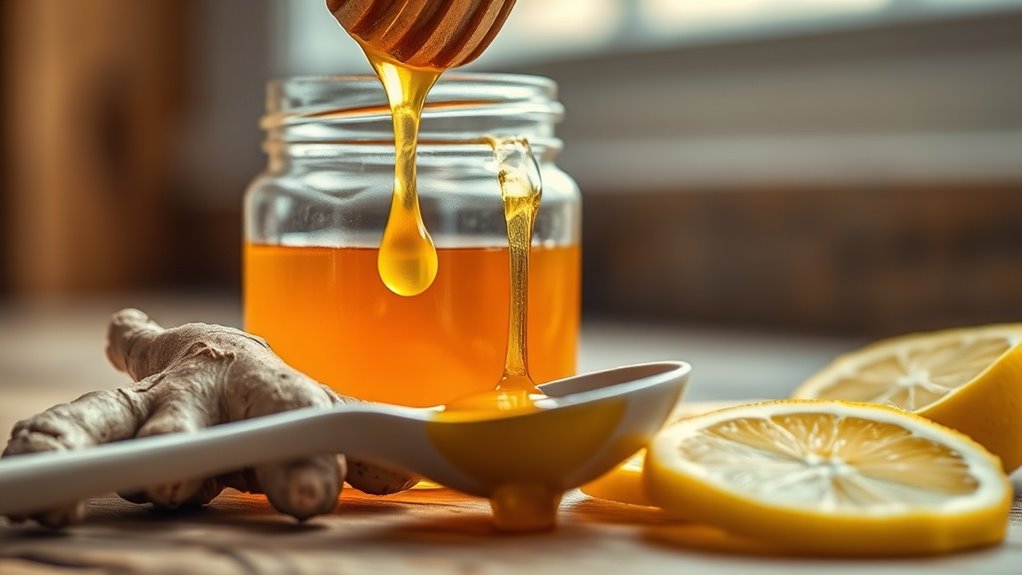
The simplicity of honey dosing enhances its practical utility as a first-line cough treatment, with well-established pediatric and adult guidelines supporting safe implementation. You can administer 2.5–5 mL (½–1 teaspoon) as a single bedtime dose for children ≥1 year, with evidence supporting efficacy at this minimal volume. Adults typically use similar teaspoon dosing repeated as needed.
Evidence-based dosing parameters include:
- Single-dose efficacy: 2.5 mL before bed substantially reduces nocturnal cough frequency in pediatric trials
- Flexible frequency: As-needed administration every 2–4 hours, typically 1–4 times daily depending on symptom severity
- Minimal effective dose strategy: Start with lower volumes (2.5 mL) and titrate upward only if symptomatic relief proves insufficient
Use commercially produced, preferably pasteurized honey. You can take honey on its own or mix into warm water or tea for easier consumption. Raw honey offers particularly effective antimicrobial properties that help coat throat tissues while inhibiting bacterial growth. You must avoid honey entirely in infants <12 months due to botulism risk.
References
- https://pubmed.ncbi.nlm.nih.gov/32817011/
- https://www.cochrane.org/evidence/CD007094_honey-acute-cough-children
- https://fshn.illinois.edu/news/honey-natural-cough-medicine
- https://www.pharmacist.com/Blogs/CEO-Blog/Article/honey-for-upper-respiratory-tract-infections
- https://jpnim.com/index.php/jpnim/article/download/080205/631
- https://jamanetwork.com/journals/jamapediatrics/fullarticle/571638
- https://www.psu.edu/news/campus-life/story/honey-proves-better-option-childhood-cough-otcs
- https://www.mayoclinic.org/symptoms/cough/expert-answers/honey/faq-20058031
- https://spice.alibaba.com/spice-basics/does-honey-soothe-a-sore-throat
- https://www.nettiesbees.com/post/how-raw-honey-fights-bacteria-the-science-of-antimicrobial-honey